
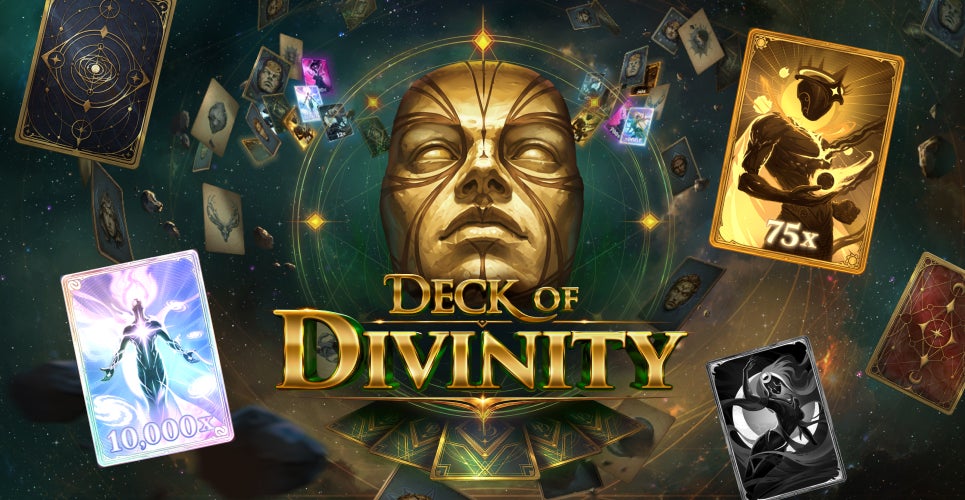
Print Studios released Deck of Divinity on 25 August 2026, which makes this a genuinely new title rather than a retrospective. That matters for how you should read any review of it, including this one — there is very little accumulated player data, no long-run session reports, and no consensus yet on how the game behaves over thousands of spins. What exists is the studio's published specification and the paytable.
So this piece sticks to what's verifiable, does the arithmetic that the specification allows, and is explicit about what you'll need to confirm in the game itself.
The headline specification
- Studio: Print Studios
- Grid: 5×4
- Win mechanic: scatter pays, minimum 5 matching symbols
- Cascades: winning symbols are removed, new ones drop in
- Prize Cards: multipliers up to 10,000x
- RTP: 96.22%
- Volatility: high
- Release: 25 August 2026
The theme is built around five decks of deities, with a restrained gold-on-dark presentation — closer to an occult card table than the usual mythology bombast. Print Studios has tended toward that kind of visual discipline, and it works here.
Why a 5×4 grid is the interesting part
This is the detail most descriptions mention and none explain.
A conventional five-reel slot uses three rows: 15 symbol positions. Deck of Divinity uses four rows: 20 positions. That's a 33% increase in board size, and on a scatter pays engine it changes the mathematics rather than just the look.
Here's why. On a payline slot, extra rows mostly add more of the same — more paylines, evaluated the same way. On a scatter pays engine, there are no lines at all. A win is registered when enough matching symbols land anywhere on the board, regardless of reel or row. So the board size directly determines how likely any given cluster is to form.
With a 5-symbol minimum on 20 positions, a winning cluster needs to occupy 25% of the board. For comparison, the better-known scatter pays format — a 6×5 grid with an 8-symbol minimum — requires 26.7%. The two ratios are close, which tells you Print Studios has tuned the threshold sensibly rather than picking round numbers. A 5-symbol minimum on a 15-position grid would have required 33% of the board, which would have made hits meaningfully rarer.
Practical consequence: the fourth row is not decoration. Remove it and the game's hit frequency drops sharply.
Cascades
After a win, the contributing symbols are removed and new ones fall into the gaps. If the new arrangement produces another win, the process repeats, and a single spin can chain several payouts before it resolves.
Two things worth understanding about cascade mechanics generally, both of which apply here:
A single spin is not a single result. Your outcome for the spin is the sum of the whole chain. Judging a spin by its first payout is misreading it.
Cascades interact with multiplier systems. In most modern designs, the multiplier component is driven by cascade length or cascade count. Whether that's true of Deck of Divinity's Prize Cards, and exactly how, is something to confirm in the paytable — see below.
Prize Cards and the 10,000x ceiling
The Prize Cards system is the game's signature feature and the route to the 10,000x maximum. Five decks of deities, each carrying multipliers.
I'll be straightforward here: I can see that this system exists and that it tops out at 10,000x, but I don't have verified detail on how cards are awarded, how the five decks differ, or how multipliers combine. Print Studios also lists Card Packs, a Divine Deck Bonus, and a SuperSlider among the game's features. Those are named systems whose mechanics I'm not going to guess at.
What I'd tell you to do instead: open the paytable and answer four specific questions before your first spin.
- How are Prize Cards awarded — by cascade count, by symbol collection, randomly, or on bonus entry only?
- Do multipliers persist between spins, or reset each spin? This single question separates a modest feature from a powerful one, and in most cascade slots the answer differs between base game and bonus round.
- Do multipliers add or multiply when several apply at once?
- Is the 10,000x figure reachable in the base game, or only inside the bonus?
Those four answers tell you more about the game than any review can.
RTP and what high volatility means here
96.22% RTP gives a house edge of 3.78%. That's a little above the market average, which sits around 96%.
One caveat that applies to nearly every studio: many ship multiple RTP configurations of the same title and let operators choose which to deploy. The figure in your casino's paytable is the one that governs your session — check it rather than trusting a specification sheet.
High volatility, combined with a 10,000x ceiling, tells you the shape of the distribution: returns will be irregular, most will be small, and the game's headline potential sits far out on a tail. That's not a criticism, it's a description. It does have a direct implication for stake sizing, though.
Bankroll: the only decision you actually make
On a high-volatility slot where the upside is concentrated in a feature, your bankroll has one job — last long enough to reach that feature more than once. A working rule: budget for at least 300 spins.
| Session budget | Sensible stake | Spins |
|---|---|---|
| £50 / €50 | 0.10–0.15 | 330–500 |
| £100 / €100 | 0.20–0.30 | 330–500 |
| £250 / €250 | 0.50–0.75 | 330–500 |
| £500 / €500 | 1.00–1.50 | 330–500 |
Worth noticing: at a 0.20 stake, the 10,000x ceiling equals 2,000 in winnings. That's what the number means in practice — and it also means chasing it by staking up is self-defeating, because a larger stake buys fewer spins and therefore fewer chances to reach the feature at all.
If your casino's minimum stake exceeds the figure your budget supports, that's a signal the game isn't matched to your bankroll rather than a reason to stake higher.
Bonus Buy and SuperSlider
Print Studios lists a bonus buy option and a SuperSlider — the latter typically being a mechanism for adjusting stake cost against feature frequency, though you should confirm what it does here specifically.
Two general points that hold regardless of implementation. First, feature purchase and stake-modifier options do not improve expected value; they change pace and variance, and they frequently carry their own RTP figure that differs from the base game. Second, availability is jurisdictional — feature buy is prohibited at UKGC-licensed casinos, so UK players won't see it at all.
On a modest bankroll, buying features on a high-volatility slot is the fastest available route to ending a session early.
Strengths and open questions
Strengths:
- 5×4 scatter pays is an uncommon and well-tuned configuration — the 25% cluster threshold looks deliberate
- 96.22% RTP is slightly above average
- Cascades plus a multiplier card system is a proven combination
- Restrained presentation, which is rarer than it should be
- Free demo available for testing
Open questions, honestly stated:
- No accumulated player data yet — the game is days old
- Prize Cards mechanics need paytable verification
- Card Packs, Divine Deck Bonus and SuperSlider are named but not documented in the material I've seen
- 10,000x invites expectations that high volatility won't often meet
- Feature buy unavailable in some markets
FAQ
What is scatter pays? Wins are formed by matching symbols landing anywhere on the grid, with no paylines. Here the minimum is 5 identical symbols.
Why does the 5×4 grid matter? Twenty positions instead of fifteen is a 33% larger board, and on a scatter pays engine board size directly affects how often clusters form.
Is 96.22% good RTP? Slightly above the market average of roughly 96%. Confirm the figure in your casino's paytable, as multiple configurations often circulate.
Is 10,000x realistic? It's a genuine ceiling but sits at the extreme end of a high-volatility distribution. It shouldn't inform your stake.
Should I try the demo first? Yes — and with a purpose. Use it to count how often the bonus triggers and how high multipliers actually climb, then size your stake from that.
Verdict
Deck of Divinity looks like a carefully built slot rather than a numbers-chasing one. The 5×4 scatter pays configuration is a genuine design choice with real mathematical consequences, the 25% cluster threshold appears deliberately tuned, and 96.22% RTP is respectable.
The honest caveat is that it launched on 25 August 2026 and nobody — including this article — has the long-run picture yet. Which is fine, as long as you approach it correctly: open the paytable and answer the four Prize Cards questions above, confirm the RTP your operator has deployed, and set a stake that buys you 300-plus spins. The house edge is 3.78% and constant. Those three actions are the whole of your influence over the outcome.